
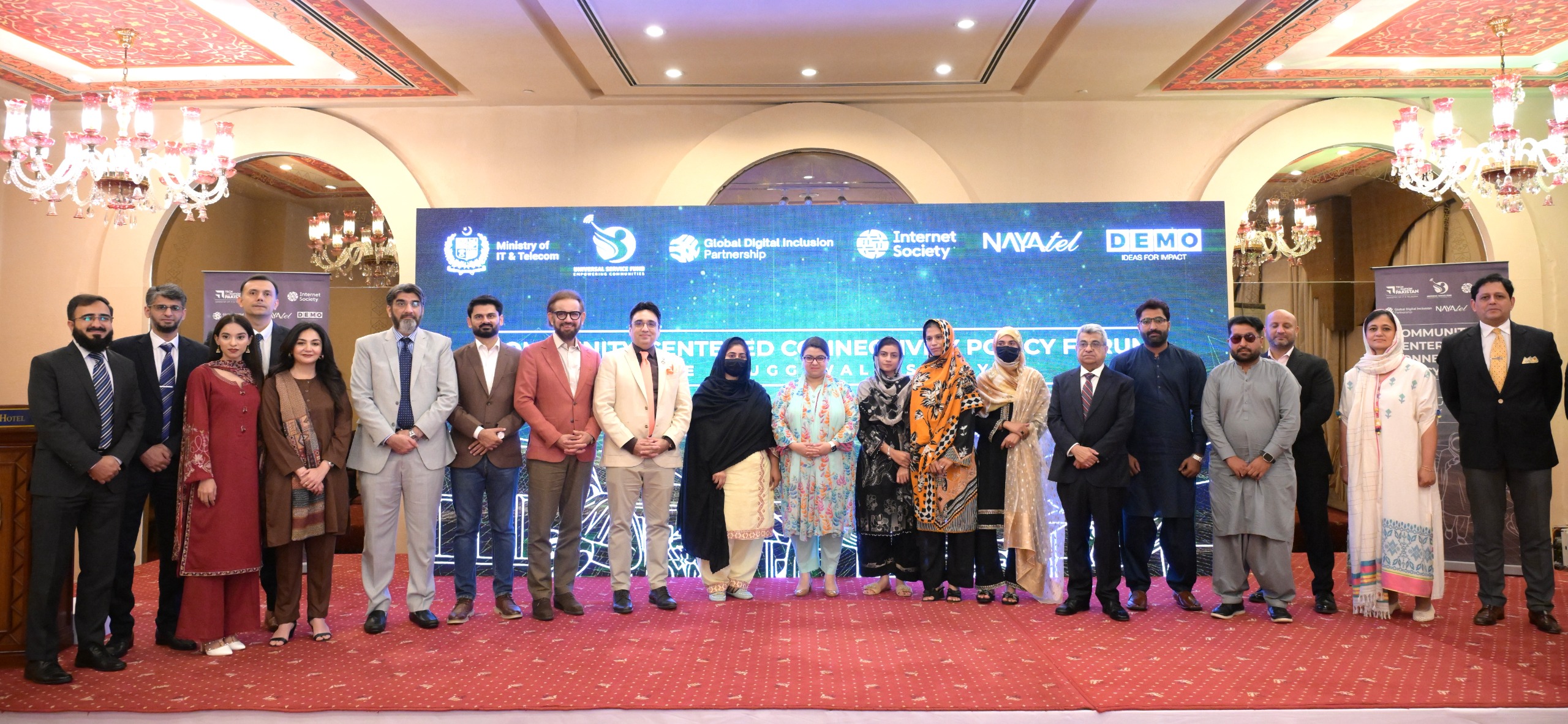
The true National transformation is impossible without full digital inclusion: Federal Minister IT & Telecommunication
The Universal Service Fund (USF) and the Internet Society (ISOC) co-hosted a high-level policy forum titled “Bridging the Digital Divide Through Community-Centered Connectivity.” The landmark event highlighted the successful completion of the pioneering “Jhuggiwala” pilot project in rural Muzaffargarh, proving Pakistan as a regional trailblazer in addressing the digital gender gap through localized, sustainable connectivity solutions.
The forum was graced by the Federal Minister for IT & Telecommunication, Ms. Shaza Fatima Khawaja, as the Chief Guest. The distinguished lineup of dignitaries included Dr. Khawar Siddique member compliance & Enforcement Pakistan Telecommunication Authority (PTA), and Mr. Naveed Haq, Senior Director of the Internet Society (ISOC).
The event brought together an elite gathering of public sector leadership, telecom executives, international development partners, and tech innovators, including, Director General Telecom Omar Rauf, Ms. Madiha Hamid (CEO, DEMO), Ms. Fareeha Ummar (Portfolio Manager, UN Women), CEO Nayatel Wahaj Siraj, Senior Officials from Jazz Mr. Zaheer Mehdi, Mr. Mudassar Hussain, and Mr. Kashif Saeed (City Head Muzaffargarh, Nayatel).
Addressing the ceremony, Federal Minister Ms. Shaza Fatima Khawaja delivered an inspiring keynote highlighting the power of deliberate policy and structured execution.
“There is no success where there is no vision,” Minister Shaza said. “That is why we have the Prime Minister’s Digital Pakistan and Digital Nation Vision. We are systematically achieving milestones to reach our ultimate destination, and the ‘Jhuggiwala’ Community Centre stands as a brilliant, shining example that we are on the exact right path.”
The Minister emphasized that true national transformation is impossible without full digital inclusion. She added,
“part in the digital economy—they drive it. We are shifting from pilots to national scaWhile Pakistan has built formidable infrastructure, the government’s focus has evolved from simple access to meaningful impact. The Jhuggiwala story proves that when you give women safe spaces, affordable access, and target skills, they do not just take le.”
Earlier, Ch. Mudassar Naveed, CEO of the Universal Service Fund (USF), delivered a powerful welcome address that set the tone for the forum. He shared a critical reality check about the regional usage gap and redefined what connectivity means for underserved communities.
• The Usage Gap: CEO USF highlighted a stark paradox: Pakistan boasts about 63% mobile broadband coverage and 68% smartphone ownership, yet less population actively uses mobile internet—including gaps in digital inclusion.
• The USF Footprint: Over the years, USF has aggressively bridged physical distances, connecting over 37 million people across 21,600 Mauzas, laying 18,000+ kilometres of Fiber optic cable, and installing 4,200+ telecom towers in commercially unviable zones.
• The New Paradigm: “Infrastructure on its own is simply not enough,” Ch. Mudassar Naveed asserted. “A Fiber cable running past a village—but not into it—does not change a child’s education. This pilot marked the first active usage on a USF Fiber node in Basti Muhammad Wali, proving that underutilized infrastructure can be transformed from a passive asset into a live engine of inclusion when paired with a trusted, community-centred model.”
The core highlight of the forum was “The Jhuggiwala Story,” a segment featuring a moving project video and live testimonies from the women of rural Muzaffargarh. Located 93 kilometres from the nearest city, the village of 13,000 residents previously lacked any socially accepted, safe avenues for women to access digital spaces or get skills.
Through a collaborative multi-stakeholder ecosystem, a renovated facility at the Government Girls High School was transformed into an ultramodern Digital Community Centre for Women. Armed with 10 high-spec computers, high-speed Fiber broadband, and localized training, the model slashed market connectivity costs by 30% by using existing USF nodes.