
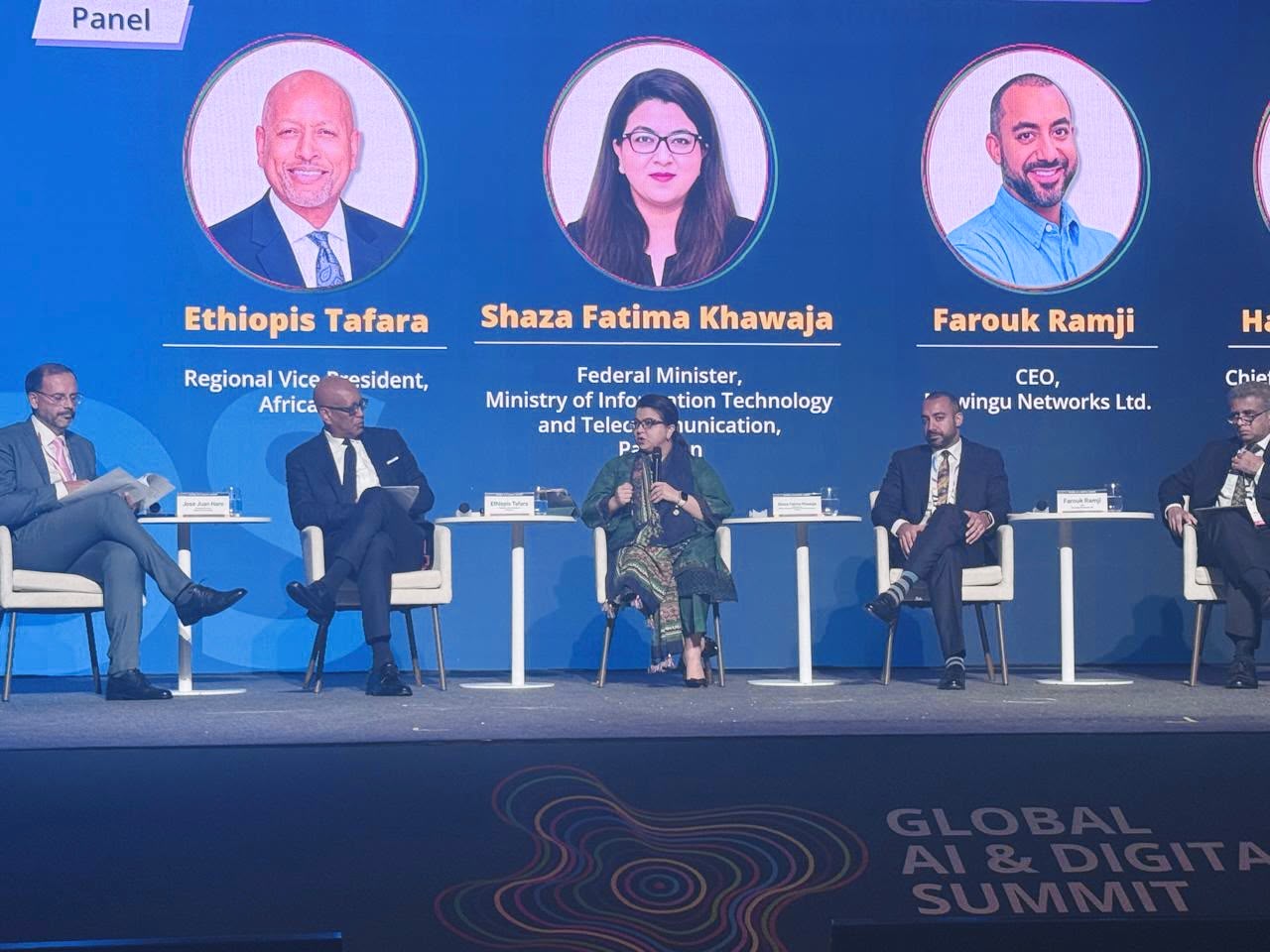
Federal Minister for IT and Telecommunication Addresses Panel Discussion at the Global AI & Digital Summit 2026
At the "Global AI & Digital Summit 2026" held in the South Korean capital, Seoul, the Federal Minister for IT and Telecommunication of Pakistan addressed a special panel discussion titled "Enabling Digital Government Service Delivery through DPI and AI," organized under the auspices of the World Bank.
Beginning the address by thanking the World Bank, the Federal Minister shared a fundamental lesson learned from Pakistan's experience: "Artificial Intelligence is the last layer, not the first. An AI model is only as good, as fair, and as trustworthy as the infrastructure beneath it. When governments skip the foundations, they do not get AI in public services; they get pilots that never scale and systems that citizens do not trust."
The Federal Minister stated that the real question is not which AI to deploy, but what must be in place before AI can serve every citizen safely.
Highlighting Pakistan's experience, the Minister mentioned the following four key foundations:
Digital Identity:
An AI service must know whom it is serving, and the citizen must stay in control of who sees their data. NADRA’s national identity system already provides a verified identity to more than one hundred million Pakistanis. Now, this is being extended into a digital identity that can authenticate a citizen online and record and enforce their consent. Identity is what allows an AI service to be personal without being invasive.
Payments:
Many public services end with money moving, such as a social protection transfer, a subsidy, or a fee. With Raast, the State Bank of Pakistan's instant payment system, a public payment rail is available. When an AI model identifies a household that qualifies for support, this rail turns that insight into delivery.
Trusted Data Exchange — WASL:
AI in government fails when each ministry's data sits in its own silo. Under the World Bank-supported Digital Economy Enhancement Project (DEEP), Pakistan is building its first national Digital Public Infrastructure (DPI) stack. At its core is WASL, the national data exchange layer. Through it, institutions share data securely and under clear rules. Every transaction is authenticated, encrypted, and logged, and citizen consent is built into the exchange. On top of WASL, a citizen "Super App" and the National Open Data Ecosystem ("NODE") are being established, giving researchers, startups, and AI developers lawful access to public data.
Safeguards National Data Governance Policy:
Designed from day one, the National Data Governance Policy issued by the Pakistan Digital Authority sets a single national rulebook for how public data is classified, shared, protected, and published. Alongside this come visible and withdrawable citizen consent, audit trails that hold institutions accountable, and a clear principle that AI supports human decisions but does not decide anyone's rights or entitlements on its own.
The Federal Minister noted that together, these four foundations make AI scalable, inclusive, and trusted.
Regarding the future roadmap, the Federal Minister stated that the government is building the AI layer on these foundations through the NAIEDP programme, which includes two core components:
Sovereign National AI Infrastructure:
The procurement and provisioning of public compute capacity so that Pakistani data is processed within Pakistan and value remains in the economy.
Pakistani LLM"Buraq":
Training Buraq, Pakistan's own large language model built on Urdu and regional languages, to make AI inclusive by design for every citizen.
Concluding the address, the Federal Minister stated that building DPI first can feel slow, but once it is in place, every AI service that follows is faster, cheaper, and safer to launch. Pakistan has chosen this path, and we are grateful to the World Bank for walking it with us.